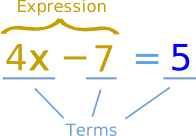
An expression in math is a statement having minimum of two numbers, or variables, or both and an operator connecting them. Learn about expressions, its parts & more.
Expressions in math are mathematical statements that have a minimum of two terms containing numbers or variables, or both, connected by an operator in between. We have different types of expressions in math such as numerical expressions, algebraic expressions, fractional expressions, etc.
In mathematics, an expression is an arrangement of symbols following the context-dependent, syntactic conventions of mathematical notation. Symbols can denote numbers, variables, operations, and functions. [1]
An expression in mathematics is a finite combination of constant or variable using operators such as addition (+), subtraction (-), multiplication (×), or division (÷).
An expression is a combination of numbers, variables, and operation symbols (like +, –, ×, or ÷) that represents a value. Unlike equations, expressions do not have an equals sign ( = ) or an inequality sign ( >, < ).
In math, an expression is the combination of numbers, variables and mathematical operators (your core operations of addition, subtraction, multiplication and division).
A mathematicalexpression is a combination of numbers, variables, and operations that represents a value. Unlike equations, expressions don't have an equal sign.
An expression in math is a statement involving at least two different numbers (known or unknown) and at least one operation. Operations may include addition, subtraction, multiplication, division...
When we combine numbers and variables in a valid way, using operations such as addition, subtraction, multiplication, division, exponentiation, and other operations and functions as yet unlearned, the resulting combination of mathematical symbols is called a mathematicalexpression.